This is a blog about me and the things that make me laugh, smile, hurt or cry!

Wednesday, September 14, 2011

What Kind of Change Do Zambians Really Want?

Naturally, with all roads leading to 20th September, we are all living and breathing the coming elections.
On Facebook, in conversations over coffee, in the queue at the supermarket etc, everyone is talking about how we want change and Zambians want to see a new government.

I wonder what this change really is.

Do we want a new government because we have a desire to see our country run in a different (and hopefully better) way? And, do we have a realistic and feasible idea of what that looks like? How will be know it when we see it? What are the steps our political leaders should take in order for us to know that real and lasting change is taking place.

Perhaps we want a new government because we are tired of seeing the same people plundering our resources? We know that mainly people seek election to public office so that they can take advantage of our weak governance and accountability structures and siphon public resources into their own and their families' pockets.  As a result, we feel that it is time 'they' shared and gave someone else a chance to 'eat'.

Or, we believe that there is a remnant of Zambians who are willing and able to make good decisions for this country, who are willing to put aside their own interests and those of their hangers on (ecosystem of friends relatives and associates hoping to get rich or die trying) in order to develop Zambia.


The Zambia that I Want:

Firstly, this country requires a new Constitution. One that will stand the test of time; one that is developed for my children's children and NOT in response to the current political climate or conditions. There is no need for another round of consultations, a constituent assembly or an NCC. All that is required is 8 to 10 knowledgeable people to draw it up and submit it to referendum or Parliament for ratification. If, as predicted, our next parliament will be a real example of multi-partyism, it would be a perfect time to adopt a Constitution for ALL Zambians and not just a few.

I also want to see a Zambia that values education and is willing to invest in our children from early childhood through to university level. We need our universities and colleges fully funded so that we can innovate and create our own solutions to our development problems. I want an education system that is closely aligned with industry and which rewards independent thinking instead of the current rote memorisation (how can this STILL be the way to pass at tertiary level)?

A national development plan or strategy that is backed up by legislation, policy, education/training and investment in key sectors. It is all very well to go around the country consulting people (and this is important), but hard and strategic decisions must be made about what we as a nation would like to focus on for our own development's sake. Some of these discussions and plans are already there, they just need more attention to make them happen well.

As a communication specialist by education and practice, I would like to see an end to state controlled media and instead, the rise of public interest broadcasting and newspapers. If our editors and journalists thought less about how to make the government and party look good, they might write more insightful and analytical articles. Despite what some people think, tabloid journalism exists in all countries (developed or otherwise), so some of the crap that is written/aired is not because it is Zambia, but on account of the deplorable state of journalism ethics and standards in the world today. However, in other countries, they have high quality journalism too, to balance things out. They have options, something which we lack in this country. NB: I note that we have independent and community media who are trying -- emphasis on trying.

We need to get more serious about fighting corruption. I definitely think that we have made a lot of positive strides in the last few years, but so much more needs to be done at all levels. So long as small-time crooks and petty corruption at village and community level continues unabated, how can we expect to stamp out corruption where hundreds of thousands of dollars are exchanged.

I think that we could do with a comprehensive transport and communication network. If the whole country was opened up for people to travel and communicate freely, so much more development could take place as the many development and investment opportunities could be more easily exploited.

We need to take maintenance seriously. I come from Chingola, once the cleanest town in Zambia. What we had was pretty good. If we valued prevention over cure, my hometown would still be a beautiful place. Once things become dilapidated and run-down, it is very expensive to fix them. But, if maintenance was something we valued, we would spend a lot less money trying to get stuff fixed and replaced.

Lastly, we need more accountability in all spheres. The Auditor General's report comes to mind here. Such exercises (important baby steps toward accountability), must count for something more than just being published. We must be seen to take clear and firm action regarding what is highlighted in the report. I know that the powers that be have taken some actions, but citizens want to see tangible evidence. This is what gives us confidence that our systems and institutions are working. So this one is probably a better PR issue. I actually think that people would be surprised just how much the government actually does that is good, we just never get to hear about it. Perhaps, we announce and publicise the wrong things. My point is that there should be no need for public outcries or donor pressure in order for decisive action that promotes transparency and accountability to taken. Members of Parliament, Councilors etc must be accountable to the people that elect them.

Related to the above point, I would similarly like to see a Zambia where ordinary citizens take a more active role in their own governance. So long as we allow leaders to get away with doing very little for four and half years, they will continue to do so. It is not for a benevolent leader to grant us effective and transparent governance but for we the people to demand it.

.

Tuesday, September 13, 2011

In Case Of Unrest... Election Day Survival Strategies

Last week, I was at my regular beauty salon and observed a sign posted on the door and counter that read something like this:

"We will be closed on Tuesday 20th Septmber for the elections and on Wednseday 21st September. The rest of the days in the week will depend on unrest."

As we gear up for elections, some observers have noted that Zambia is fortunate precisely because we don't know what the outcome of the election will be. In other African countries, everyone knows and election day is just a formality. Either people are intimidated into voting for the ruling party or the elections will be rigged regardless of what citizens, NGOs and donors say. Happily for Zambia, that apparently is not the case here.

There are those who firmly believe the ruling party will remain just that; and there are also those who are confident that Zambians are ready for change and will say so at the polls.

Others maintain that Zambia is in a good place because our young democracy has grown enough in the last few years to make rigging a lot more difficult than it was a decade ago. Technology of voting tools, training and awareness of election staff, monitors etc and the knowledge of the general public about the rules and procedures has advanced dramatically since the second and third republics.

Whatever the case, my visit to the beauty salon reminded me of the cold hard facts. We may be slightly better off than some other countries (whatever that means), but the reality is that in the Africa that we live in, civil and political unrest remains a reality. What does everyone do in the days leading up to an election? We fall back on the basic survival strategies that are tried and true:

1. You fuel up your car and make sure you have a full tank because you don't know what will happen to the fuel supply system, prices etc
2. You make sure your freezer and pantry are stocked with basic food supplies
3. You also ensure that there is enough bottled water to drink and that the drums and containers are also filled up in case the water supply is affected
4. You buy enough candles, kerosene/paraffin and charcoal, just in case the load shedding becomes 3 days instead of 3 hours
5. You make sure you have enough airtime in your phone in case it is not safe to go outside to top-up.
6. You even pull out your old radio that you haven't used in ages. This is just so that you can tune in to BBC at the appropriate time. Depending on how the results go, you can't be too sure if the local news outlets can be trusted
7. Lastly, but not least, you put your important papers and documents in order, in the event that you and your family must flee.

The way I see it, we cannot ever have free and fair elections until as Zambians we no longer feel the need (openly or privately), to resort to the above default strategies whenever election time rolls up. I strongly feel this will only happen when the citizens of this country have enough confidence in our governance institutions to know that justice will be administered no matter who you are or what you have done.

.

Monday, August 8, 2011

Walking Down the Streets of Soweto

"Bring back Nelson Mandela, 
 Bring Him Back home to Soweto
 I want to see him walking down the streets of South Africa tomorrow!"


The broadway musical, Sarafina! (also later made into a movie), made Masekela's song even more popular 
These famous words from the song, Bring Him Back Home by Hugh Masekela ran through my mind as we drove into Soweto on a recent visit to South Africa. It wasn't a tourist trip as one might assume. I accompanied a friend, who accompanied a friend who was invited by another friend to tag along while he visited his friend who lived in Soweto. That's a lot of friendships. Fortunately, the friend who was driving, understood that it's not everyday that a foreigner gets to visit Soweto (when not on a guided tourist trip). Hence my friend and I got to tag along with our other friend.

The FNB Stadium in Soweto (known as Soccer City during the FIFA 2010 World Cup)
As a Zambian, I am very proud of the role that my country played in the liberation of Southern Africa, and especially of South Africa. The comradeship that characterised our leaders' relationships in the 50s and 60s is perhaps something that can never be recaptured. 

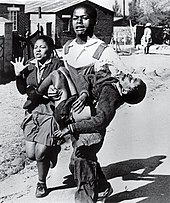
June 16, 1976 -- Hector Pieterson being carried after being shot
Being in Soweto also brought to mind the Soweto Uprising of June 16th, 1976. In the rest of Africa, this day is commemorated as The Day Of the African Child as designated by the African Union (then Organisation of African Unity - OAU) in 1991. That day is remembered by the iconic picture of a boy named Hector Pieterson, who was shot and later died as police fired on school children protesting the government's newly introduced policy to teach in Afrikaans. We didn't visit the Hector Pieterson museum, but we did see the sign.

The museum is that way

We also passed by the famous Regina Mundi church, where many of the children in the Soweto uprising ran to for safety. Because public gatherings were banned, the church was the only place where black South Africans could legally meet. As such, many meetings and discussions took place within the sacred walls of this particular catholic church.

Soweto's Iconic Landmark Feature -- the Orlando Power Station Cooling Towers
The Orlando Power Station cooling towers is one of the most iconic Soweto images. They appear almost everywhere that Soweto is depicted. One tower contains South Africa's largest mural paintings, while the other is a massive advertising billboard. The towers were decommissioned several years ago, but they are the site of bungee jumping and other adrenaline sports.

Winnie Mandela's House
Naturally, we swung by Winnie Mandela's house too. There really wasn't much to see, other than the glaring absence of the Zambian flag. I will give them the benefit of the doubt and conclude that it was being washed.

Can you guess who the main residents of the Soweto sub-township of Lenasia are?
It was interesting to be in a place to which we were once all so connected. It represented an ideal -- that until we are all free, then none of us in African are free. Walking and driving through the streets of Soweto, so many things were familiar. It is Africa after all. From the roadside businesses and advertisements showcasing everything and anything, to the people gathered around a mechanic's having a drink. The hairdresser's is always a busy place and there is one on every corner, just like you will find grocery stores, churches and Coca Cola containers. The school playgrounds look pretty much like they do back home. Everybody avoids being crammed four-four in the back seat of the mini-buses that they call taxis here.

Slag heaps from years of mining are a familiar sight to any Zambian from the Copperbelt
At the same time, while a lot of what I saw was the same, it was also very different. Off the top of my head, two examples come to mind: 1. The varying levels of affluence within the township are much more evident than in Lusaka or Kitwe. 2. The dressing is quite different too. Women wear shorter skirts and dresses -- not as short as in town, but definitely shorter than back home.

.

Friday, July 29, 2011

Fifty-two Days to Go

Yesterday, President Rupiah Banda dissolved Parliament and announced the date of the 2011 tripartite elections to be Tuesday, 20th September.


I have always voted on principle. I don't believe in the whole "don't waste a vote" school of thought, which means everybody just votes for the most popular opposition candidate regardless of who the person standing is. This way, no one needs to take any responsibility for their vote. 


In our 'Westminster' or constituency system, each candidate is voted for by the people (as opposed to the party in a proportional representation system). In theory, this means that s/he is also accountable to the people. We are far from reaching this level of accountability in our governance system, but I do think that we have the right foundation to strenghten and build on our system.


In light of recent events in Malawi and earlier this year in North Africa, I am hopeful for peaceful elections and for a free and fair campaign period.


Hope often disappoints. In fact, the Bible says, "Hope deferred makes the heart sick". Nevertheless, Hope is free and that's where I'm putting my money. 


Someone once said, "without pressure, there is no expectation". So, as I look up to the world with hopeful expectation, fingers crossed that I don't get spat in the face.


Wednesday, June 8, 2011

Thirty Years of Living With and Being Affected By HIV and AIDS

Who would have thought we would still be living with and affected by HIV and AIDS some 30 years after it was first reported? 


UNAIDS estimates that 34 million [30.9 million–36.9 million] people are living with HIV and nearly 30 million [25 million–33 million] people have died of AIDS-related causes since the first case of AIDS was reported on 5 June 1981. The agency has released a report, AIDS at 30 
The report found that in the third decade of the epidemic, people were starting to adopt safer sexual behaviors, reflecting the impact of HIV prevention and awareness efforts. However, there are still important gaps. Young men are more likely to be informed about HIV prevention than young women. Recent Demographic Health Surveys found that an estimated 74% of young men know that condoms are effective in preventing HIV infection, compared to just 49% of young women. 
In recent years, there has been significant progress in preventing new HIV infections among children as increasing numbers of pregnant women living with HIV have gained access to antiretroviral prophylaxis during pregnancy, delivery and breastfeeding. The number of children newly infected with HIV in 2009 was 26% lower than in 2001.


In New York, world leaders have gathered (from 8–10 June 2011) for the 2011 UN General Assembly High Level Meeting on AIDS. I am sure they are discussing how the heck the world failed to get control of this disease. I am pretty sure no one thought that it would be this big, be around for so long, nor devastate as many lives as it has.


At the same time, the doom, gloom, fear, stigma and ignorance of the 80s and 90s left many unable to believe that people could still have quality of life and be HIV positive. Many who were working in public health back in 1981 would have little idea that people would be able to live for decades with the virus. I would say that in countries such as ours, being ostracised because of HIV is rare. AIDS is just too prevalent in our society for us to ignore it anymore.


We are ALL affected.


Certainly, discrimination still happens and you don't get open disclosure of sero-positive HIV status very often, but we have surely come a VERY long way in our knowledge and understanding of what it means to be living with and affected by HIV and AIDS. This is thanks in large part to our founding father Dr. Kenneth David Kaunda who took the brave and bold step of publicly accepting the reality of AIDS in his own family way back in 1989 and ensured that Zambia would take a leading role in successfully responding to the pandemic.


I first became an HIV activist in 1996, when I joined the Anti-AIDS club at college. I transferred to the University of Zambia in 1997 at the beginning of the abstinence movement. Back then, it was all about condoms. The abstinence crew were ridiculed and struggled to find funding outside of the church. Then, George Bush and the Mexico City Policy (or Gag Rule) came along and changed the landscape of the HIV response. Abstinence became all the rage and the ABC lost favour and began to fall out of fashion.


I remember the firm stance taken by former Heath Minister Brigadier General Dr Brian Chituwo who was instrumental in making clear that government policy supported all the ABC options.


Some years after the Gag Rule was re-introduced, George Bush came up with another idea; the President's Emergency Plan For AIDS Relief (PEPFAR) committed USD5billion over five years to AIDS related projects.


I also recall the first efforts to ensure access to treatment for all and the subsequent struggle for attention to prevention efforts (in my view, the most important aspect of the HIV and AIDS response). The statistics tell us that there are more people who are not infected with HIV and we should be doing all we can to keep it that way. At the same time, it is encouraging that we now have options to ensure that people live longer and healthier lives and are able to contribute to a productive economy, to society and to culture. If anything, the zeal, determination, drive and motivation of PLWAs at many times adds up to much more than the lazy and dependent attitudes of the apparently healthy who contribute nothing to our country and only drain it of limited resources.


Over the years, I have noted how we have had to change our vocabulary. We have learnt to be more inclusive and less combative. We try to judge and condemn much less. However, you still see and hear the ignorant refer to AIDS patients, innocent victims and fighting AIDS.


An unfortunate development over the last 30 years has been the increasing number of children living with HIV. The sad reality is that because this disease does not affect Western countries to the same degree, the level of funding and interest in research will not bring about huge rewards as the people who need the drugs/cure cannot afford to pay premium prices.


CNN has done a great 30 year Timeline of AIDS that is very interesting.


.

Tuesday, May 24, 2011

Africa Freedom Day

Tomorrow, 25th May is what we in Zambia commemorate as Africa Freedom Day. Many other countries just call it Africa Day. This year, according to the Inter Press Service, Africa Day focuses on Youth and Development.

'Africa is the world's second largest and second most-populous continent; it is rich in diversity, abundant in ethnicity and bursting with languages. Africa Day (25 May), which marks the founding in 1963 of the Organization of African Unity, now known as the African Unionprovides an annual opportunity to reflect on the challenges and achievements of the Governments and peoples of Africa.
This year Africa Day will be celebrated all over the continent and in the Diaspora under the theme: “Accelerating Youth Empowerment for Sustainable Development’’. Africa Day is a day designated specifically to the celebration of African diversity and success.  It is an opportunity to acknowledge the progress that African countries have made, while reflecting on the challenges faced in a global environment'.
'Freedom'
 The statue can be viewed at the Government Complex in Lusaka

To be honest, I have never really sat down to think about what Africa Freedom Day means to me. I, like many others, simply put it down to being another public holiday when I can kick back and relax. And yet, it grieves me that our society (and this includes the government), does very little to add meaning to what should be a sacred day. The survivors of the holocaust vowed to keep on telling their stories so that the world would "Never Forget". What are our African stories that we should choose to never forget? What does our Independence Day mean to us in 2011. Do we even remember what it was for and the price others paid to set us free? What about Heroes and Unity day? What is that all about, other than being Trade Fair weekend? Our flag independence may mean little with the hindsight of 50plus years, but if given a choice, who would choose to turn back the clock an remain in oppression, ruled by invaders from a distant land. 

As a Zambian, I should never forget the proud heritage of my country in setting this continent on the road to freedom. However, as a young person living in the 21st century, I want history to remember Zambia for what we did to take Africa and it's people forward. We should not forget the past, but neither should we always look back on it with doe-eyed fondness. We have so much more work to do to tackle poverty, disease, corruption,  dependency ...the list goes ever on. 

Nevertheless, one day, Zambia Shall Be Free!


Picture: Lusaka Times

Saturday, April 16, 2011

Football Fanaticism vs Patriotism

Recently, I got into an online discussion with a friend about football. He and I support opposing teams in the English Premier League. Our conversation turned to the unhappy fact that many supposed football fans are unable to have a rational conversation about the sport or their team with other supporters. This was prompted by my posting a comment about our Manager, who accused the opponents in the upcoming match of being obsessed with the Champion's league. I assured my friend that I consider myself to be one of the few enlightened football supporters.


For those in doubt about where my football 'allegiance' lies

I love my team, but I see no need to insult other people because they support another team. Do people have nothing else to do with their lives than engage in fake and extremely contrived rivalry that is just plain ridiculous.

If more people in Zambia applied as much passion, loyalty, dedication, time, effort, energy and finances to the state and welfare of our nation, as they do to football, Zambia would be a great country indeed. Fathers would spend more time with their children and many a bar would go out of business (no major loss in my book -- perhaps HIV and gender based violence would conversely reduce also). If our political and corporate leaders were half as interested in development as they are in football, we would be a middle income country right now and not by 2030. Our national football team rarely struggles to raise funds from the national budget or from big business sponsors. At the same time, if we invested a fraction of the time and money that we do in foreign football into the local game, our national team would a have a steady supply of quality players. Then, perhaps I would consider the Chipolopolo Boys as deserving of my devoted attention. 

It distresses me that people get so emotional about football, but not many of the injustices we see around us everyday. If we were as patriotic as we are blind supporters of football clubs, to the point of insulting or beating up other fans after the loss of our team, our country would be in a much better place. And patriotism is not the same as supporting the national team. We are so forgiving of football teams, players, managers etc, but are so quick to jump ship and abandon our country (figuratively or physically) when things get rough. We take time to plan our schedules and finances around the sport, but will not go out of our way to support local businesses and products. A mediocre and under-performing team still gets people crammed into a bar to watch another defeat.


Don't get me wrong, I am a loyal (but informed and rational) football and Manchester United fan. I went to the world cup in South Africa, for the love of the game. But honestly, some football supporters need to get a life. 


It is for this reason, that I rarely have football conversations with the unenlightened and ignorant majority of football supporters.


.